

The Member Onboarding Process That Actually Cuts Early Churn

Run a phased 30-day onboarding sequence anchored by three human touchpoints — Day 3, Day 14, and Day 30 — and you’ll fix the leak that kills most member-based organizations before it starts. The ASAE research on structured onboarding shows organizations using intentional multi-touch onboarding push first-year retention from around 62% up to 68% or higher. Fitness Flow’s operational data backs the same pattern in gyms specifically: members who book a second visit before they walk out the door on Day 0 stick around far longer than members who leave “to think about it.”
Your core success metric isn’t a signed contract. It’s three things happening in the first two weeks:
- A booked second visit or class, confirmed before the member leaves the building
- Autopay verified and active, not just “set up”
- At least one social connection made, whether that’s a buddy, a coach, or a class group
Three actions to start today, regardless of your current system:
- Book the member’s next session before they leave sign-up
- Schedule an automatic Day 3 check-in
- Put a manual Day 14 call on a real person’s calendar
Key Takeaways
A structured 30-day member onboarding process built around Day 3, Day 14, and Day 30 touchpoints prevents the silent churn that kills first-year retention.
PointDetails
Book before they leave
Confirm the member’s next session on Day 0, before sign-up ends, to raise return rates immediately.
Day 14 is the critical call
Make this touchpoint manual and human; it catches red flags automation misses.
Track visits and class attendance separately
Fewer than 3 visits or zero classes by Day 14 should trigger same-week outreach.
Automate flags, not relationships
Use software for reminders and dashboards; keep goal-setting and Day 14 calls manual.
Fitness Flow operationalizes the sequence
Its CRM, reporting, and member app surface red flags and handle booking automatically.
Table of Contents
- Why the Member Onboarding Process Is Your Highest-ROI Retention Lever
- The Day 0 to Day 30 Onboarding Playbook
- Building the Core Onboarding Sequence and Materials
- What Metrics Actually Predict Early Churn
- Making Onboarding an Operational System, Not a Hope
- How Fitness Flow and Real Onboarding Data Inform This Playbook
- Attendance Tracking and the Red-Flag Scan in Practice
- What Most Onboarding Advice Gets Backwards
- Run This Playbook Without Building It From Scratch
- Sources
- FAQ
Why the Member Onboarding Process Is Your Highest-ROI Retention Lever
Most member-based organizations spend heavily on acquisition and treat onboarding as an afterthought, a welcome email and a locker assignment. That’s backwards. The ASAE data on structured, intentional onboarding shows a jump from roughly 62% to 68%-plus first-year retention when organizations deploy multi-touch onboarding instead of a single orientation event. That gap, applied across a membership base of any real size, dwarfs what most gyms spend on retention marketing in a year.
Statistic Callout: Organizations using structured, multi-touch onboarding see first-year retention climb from around 62% to 68% or higher, according to ASAE’s research. A structured 30-day cadence with Day 3, Day 14, and Day 30 touchpoints is the specific mechanism that produces it.
The real threat isn’t the member who cancels loudly. It’s the one who ghosts.
- They stop showing up between week two and week four, no complaint, no cancellation request
- Nobody notices until the next billing cycle flags a card decline or a cancellation request
- By then, re-engagement is nearly impossible; the relationship is already over in their head
Onboarding built around these gaps is cheap insurance. A Day 14 phone call costs a staff member ten minutes. A member who churns silently in month two costs you the full lifetime value you paid to acquire them.
The Day 0 to Day 30 Onboarding Playbook
This is the sequence. Assign an owner to each step, write the scripts down, and make escalation automatic rather than optional.
1. Day 0: Lock in commitment before they leave
The single highest-leverage move in the entire member onboarding process happens in the first fifteen minutes. Confirm the payment method is active, not just entered. Then book their next session, whatever that means for your organization, before they walk out. Practitioner data on the booking-first-session effect shows members who leave with a session already on the calendar show up at dramatically higher rates than those who leave to “figure out their schedule.”
Follow that with a short goal-setting conversation, ten minutes, no more. Ask what they actually want (weight loss, a race, general health, stress relief) and write it down somewhere staff can reference later. This single conversation becomes the anchor for every future check-in.
Owner: Front desk or sales staff who closed the membership. Script: “Before you head out, let’s grab your spot for [day/time] this week. And tell me, what’s the one thing that would make the next 90 days feel like a win for you?”
2. Day 3: The warm check-in
A short SMS or a 90-second call. The goal is simple: confirm the first session actually happened and felt good, not transactional relationship management.
Owner: Front desk staff or an assigned onboarding coordinator. Script: “Hey [name], how did your first session feel? Anything confusing or anything you want more of?”
3. Day 14: The manual call that saves the membership
This is the point where Rework’s operational research identifies the single biggest churn risk, and it’s the one touchpoint you should never automate away. A real person calls or messages, asking direct questions that surface friction before it becomes a cancellation.
Questions to ask:
- “How many times have you been in since you joined?”
- “Have you tried a class yet, or still doing solo sessions?”
- “What’s the biggest thing getting in the way of you coming in more?”
If the answers reveal red flags, low visit count, no class attendance, vague or defensive responses, escalate immediately: offer a free intro class, a complimentary PT taster session, or a direct introduction to a staff member who can address their specific barrier.
4. Day 30: Milestone review and handoff
Close the loop on the goal set on Day 0. Did they hit it, or get closer? Celebrate whatever progress exists, even small progress, then set the next 30-day target together. This is also the moment you formally hand the member off from “onboarding” into your ongoing engagement programming, classes, challenges, community events.
Pro Tip: Keep every script under 30 seconds when read aloud. Staff skip long scripts under time pressure; short ones actually get used.
Building the Core Onboarding Sequence and Materials
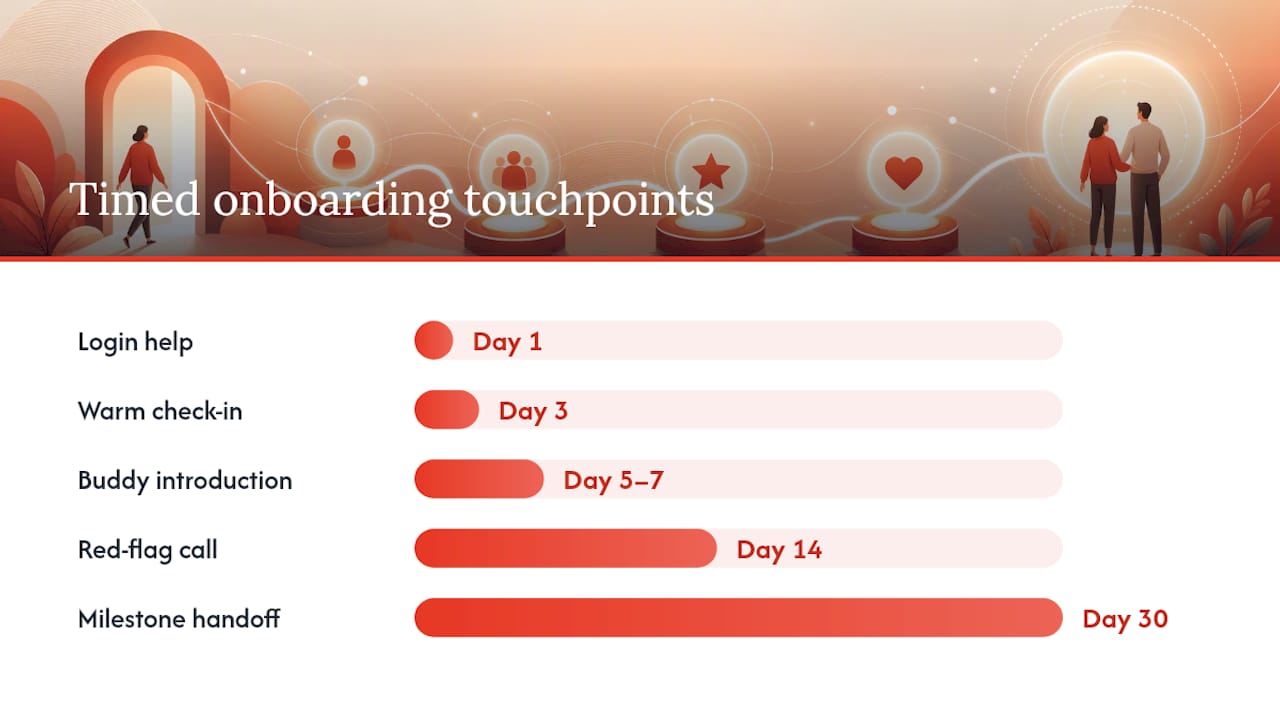
Your welcome sequence should run on a fixed calendar, not staff memory. Here’s the channel logic that works across most member organizations:
DayContentChannel
0
Welcome message, goal confirmation, next session booked
In-person + email
1
Portal/app login instructions, quick-start resources
3
Warm check-in on first session experience
SMS or call
5 to 7
Class schedule highlight, buddy introduction if applicable
Email or app push
14
Manual red-flag call, barrier questions
Phone call
30
Milestone recap, next goal set, engagement handoff
In-person or call
Email works for information members need to reference later, schedules, portal links, resource guides. SMS and WhatsApp work for anything time-sensitive or emotionally warm, a check-in, a reminder, a congratulations. Never put a Day 14 red-flag conversation in an email; it gets ignored or misread.
The first-login experience on your member app or portal should deliver one quick win immediately: a completed profile, a booked class, or unlocked access to a resource like a nutrition guide or workout library. Members who get a fast, visible payoff from logging in return to that app. Members who hit a blank dashboard don’t.
Buddy or peer pairing works best when it’s formal rather than hopeful. Don’t just tell a new member “people here are friendly.” Pairings should happen within the first 21 days, with a named introduction, “Sarah, meet James, he’s also training for a 10K and usually hits the Tuesday 6am class.” Naming a specific class and time turns a vague suggestion into an actual plan.
When inviting members to events or classes, always propose a specific slot rather than a general “come check it out sometime.” Faster time-to-first-value correlates strongly with retention across subscription services generally, and a fitness membership behaves the same way. The gap between “you should try a class” and “you’re booked for Thursday’s 6pm HIIT class” is the gap between a member who shows up and one who doesn’t.
What Metrics Actually Predict Early Churn
You don’t need forty metrics. You need five to seven that predict risk early enough to act on it.
- Visits in the first 14 days — the single strongest early signal
- Classes attended by Day 14 — solo-only members with zero classes are a flag
- Response rate to Day 3 and Day 14 outreach — silence itself is a signal
- Autopay verification status — a failed or unconfirmed payment method predicts disengagement
- Sessions booked before the member left sign-up — your leading indicator, measured on Day 0
Academic work on service usage patterns backs the visit-frequency logic directly: early usage frequency predicts longer-term retention across service settings well beyond fitness.
MetricRed-flag thresholdResponse
Visits by Day 14
Fewer than 3
Trigger manual outreach same week
Class attendance by Day 14
Zero classes attended
Offer a free guided intro class
Day 3 check-in response
No reply within two days
Escalate to phone call, not another text
Autopay status
Unconfirmed or declined
Immediate front-desk follow-up
Run this as a weekly review, not a daily fire drill. Your onboarding coordinator pulls the list of members at Day 14 who haven’t hit visit and class thresholds, works the phone for an hour, and logs outcomes. That single weekly hour, done consistently, catches most of the churn that would otherwise show up invisibly on next month’s billing report.
Making Onboarding an Operational System, Not a Hope
Assign clear ownership per touchpoint: front desk owns Day 0 and Day 3, a designated onboarding coordinator owns Day 14, and either the coordinator or a coach owns Day 30. Handoffs fail when they’re implied rather than written down, so put the owner’s name next to each day on whatever system you use.
Automate the reminders, not the relationship. Timed SMS nudges, dashboard flags for missed visits, and autopay alerts belong in software. The Day 14 call and the Day 1 goal-setting conversation do not; manual check-ins at these specific milestones outperform automated equivalents for smaller organizations especially, because members can tell the difference between a bot and a person who remembers their name.
For studios under roughly 300 members, a shared Google Sheet with checkboxes for Day 3, Day 14, and Day 30, reviewed weekly by one assigned coordinator, is genuinely sufficient. Past that size, CRM triggers that auto-flag missed milestones save the coordinator from manually scanning rows. Either way, budget roughly 15 to 20 minutes of staff time per new member across the full 30 days, most of it concentrated in the Day 14 call.
Pro Tip: Don’t build a beautiful automated sequence and skip the Day 14 call because “the system handles it.” The system flags the risk. A person still has to make the call.
How Fitness Flow and Real Onboarding Data Inform This Playbook
This playbook draws on operational patterns Fitness Flow has observed across independent and multi-location gyms running structured onboarding through its CRM and scheduling tools, combined with the published research cited throughout this piece.
- Fitness Flow’s CRM tracks booked sessions, autopay status, and class attendance automatically, feeding the exact KPIs this playbook depends on
- Its member app handles the first-login experience and buddy introductions directly, reducing the manual coordination load on staff
- Reporting dashboards surface Day 14 red flags automatically, so the coordinator’s weekly review takes minutes instead of hours
The gap between organizations that treat onboarding as a checklist and those that treat it as a system shows up directly in retention numbers, not in anecdote.
Louis, author of this piece, has covered gym operations and retention systems extensively; explore related coverage on switching gym software without losing members for adjacent operational guidance.
Attendance Tracking and the Red-Flag Scan in Practice
Attendance data only matters if someone actually looks at it before Day 30. Most organizations collect the data and review it too late, at the 60 or 90-day mark, when the member has already mentally checked out.

Track two separate numbers, not one blended metric. Total visits tells you engagement volume. Class participation specifically tells you social integration, since members who only do solo sessions rarely form the community bonds that predict long-term retention. A member with five solo visits and zero classes by Day 14 carries a different risk profile than a member with three visits split across two classes, even though the raw visit count looks similar.
The red-flag scan itself should be a five-minute task, not a data analysis project. Pull the list of members who joined 14 days ago. Sort by visit count. Anyone under three visits or with zero class attendance gets a phone call that week, not an email, not a task added to a backlog. The scan works because it’s boring and repeatable, run the same way every single week regardless of how busy the front desk is that day.
Where this breaks down is inconsistency: skip the scan for two weeks during a busy month, and the members who needed intervention in week two are gone by week four with no record anyone noticed.
What Most Onboarding Advice Gets Backwards
Most onboarding guides treat automation as the finish line, build a slick welcome sequence, add some app push notifications, call it done. That advice optimizes for the easy 80% and abandons members precisely when they’re most likely to leave.
The data doesn’t support that priority order. The Day 14 window is where churn actually gets decided, and it’s the one moment automation handles worst. A text message can remind someone to book a class. It cannot ask “what’s actually getting in your way” and adjust based on the answer. That distinction gets lost when organizations chase efficiency before they’ve earned it.
If I had to rank priorities for a gym or studio building this from scratch, I’d put the Day 0 booked-session habit first, since it’s nearly free and produces an outsized effect, the Day 14 manual call second, and the welcome email sequence dead last. Most operators build it in the reverse order because email sequences are easier to set up than staff discipline around phone calls.
Automation should exist to make the manual work findable, not to replace it. That’s the whole argument this playbook makes.
— Louis
Run This Playbook Without Building It From Scratch
Every touchpoint in this playbook, the Day 0 booking, the Day 14 red-flag scan, the autopay check, requires data living somewhere staff can actually see it in time to act. Fitness Flow was built by a gym, for gyms, specifically so that data doesn’t sit buried in three different systems.
Its CRM captures booked sessions and payment status automatically, so the Day 0 checklist becomes a dashboard view instead of a paper form. Its reporting flags members hitting the Day 14 red-flag thresholds, visit count and class attendance, before your coordinator has to go hunting for them. And the branded member app handles first-login walkthroughs and class booking directly, so members get their quick win without a staff member walking them through it manually.
If you’re running this playbook on a spreadsheet right now and it’s holding, that’s fine for under 300 members. Once the coordinator starts missing Day 14 calls because the list takes too long to pull, it’s time to automate the flagging. Book a demo with Fitness Flow to see how the CRM, scheduling, and member app map directly onto this 30-day sequence.
Sources
- Start strong: five onboarding strategies to set your new members up for success
- New Member Onboarding for Gyms: The First 30 Days That Determine Retention
- Gym Member Onboarding: First 30 Days Guide
FAQ
What Is Member Onboarding?
Member onboarding is the structured process of guiding a new member from sign-up through their first 30 days, using scheduled touchpoints to build habits, confirm engagement, and catch churn risk early rather than leaving retention to chance.
What Are the Four C’s of Onboarding?
Definitions vary across industries, but a common version covers compliance (paperwork and rules), clarification (role and expectations), culture (values and norms), and connection (relationships with staff and peers). For gyms, the equivalent is waivers, goal-setting, community norms, and buddy pairing.
What Are the Steps of the Member Onboarding Process?
The core steps are Day 0 (payment confirmation, booked first session, goal-setting conversation), Day 3 (warm check-in), Day 14 (manual red-flag call), and Day 30 (milestone review and handoff to ongoing engagement).
What Are the Five Pillars of Onboarding?
Common frameworks reference compliance, clarification, culture, connection, and check-ins as the five pillars, though exact terminology differs by source. In a gym context, the check-in pillar maps directly to the Day 3, Day 14, and Day 30 touchpoints in this playbook.
How Does Fitness Flow Support the Onboarding Process?
Fitness Flow’s CRM, scheduling, and member app automatically track booked sessions, autopay status, and class attendance, surfacing the exact red-flag data an onboarding coordinator needs for the Day 14 call.