

Predict Profit Weeks Early: 8 Gym KPIs Owners Can Calculate This Week

Track eight numbers and you’ll know whether your gym is healthy months before your bank account tells you: lead-to-member conversion, monthly recurring revenue, average revenue per member, member lifetime value, churn, cost per acquisition, class or floor utilization, and revenue per square foot. Of those, one ratio matters more than the rest, LTV to CAC, because it tells you whether members are worth more than it costs to get them, but watch it alongside ARPM and churn since a great ratio can hide a shrinking membership base. Calculate all eight this week, build a one-page dashboard, and revisit it every Monday.
TL;DR:
- The most critical ratio for gym health is the lifetime value to customer acquisition cost, but it must be considered alongside ARPM and churn to avoid masking a shrinking membership base.
- Tracking lead-to-member conversion, monthly recurring revenue, member lifetime value, churn, and utilization provides targeted insights to address specific operational issues effectively.
- Regular review of core metrics should be weekly for lead volume and conversion, monthly for ARPM and churn, and quarterly for LTV and pricing adjustments to catch trends early.
- Automated systems like Fitness Flow centralize data, eliminating manual reconciliations and providing real-time dashboards for better decision-making.
- Benchmarks vary widely depending on gym size and model, with boutique studios typically having higher LTV and lower churn compared to big-box gyms, making context crucial for interpretation.
Getfitnessflow
Make Gym KPI Decisions Simpler
Fitness Flow centralizes gym data with insightful analytics, helping owners make data driven decisions without multiple software subscriptions.
Table of Contents
- What Gym KPIs Actually Measure (and Why Owners Ignore the Wrong Ones)
- How Do You Calculate Each Gym KPI?
- What Are Good Benchmark Ranges for Gym KPIs?
- How Often Should You Review Gym KPIs?
- How Software Turns Raw Gym Data Into KPIs
- My Advice: Start Small, Automate Fast, Adjust Often
- Fitness Flow: Stop Rebuilding Your KPI Report Every Sunday Night
- Where These Benchmarks and Formulas Come From
- Sources
- FAQ
What Gym KPIs Actually Measure (and Why Owners Ignore the Wrong Ones)
Most gym owners track revenue and member count. Those two numbers tell you almost nothing about why the gym is struggling or thriving. Gym KPIs, the fitness performance metrics that break revenue and retention into their component parts, tell you which lever to pull and when.
Lead-to-member conversion measures the percentage of trial visits, walk-ins, or free-class attendees who sign a membership. A low number usually means your sales process is broken, not your marketing. If 200 people tour your facility monthly but only 20 join, the front desk conversation needs work more than your ad budget does.
Monthly recurring revenue (MRR) is the predictable subscription income from active memberships, excluding one-off sales like personal training packages or retail. It’s the closest thing a gym has to a heartbeat monitor.
Average revenue per member (ARPM), sometimes called ARM, shows how much each member generates monthly across dues, add-ons, and retail. A gym charging $99 a month with strong supplement and personal training upsells might post an ARPM of $140. That gap is pure margin opportunity.
Member lifetime value (LTV) projects total revenue from an average member over their full membership tenure. It’s the number that justifies (or kills) your marketing spend.
Churn is the percentage of members who cancel in a given period. Retention is its inverse.
Cost per acquisition (CPA), sometimes tracked as cost per lead (CPL) earlier in the funnel, tells you what you’re actually spending, in ad dollars, referral incentives, and staff time, to land one paying member.
Utilization, whether measured as class fill rate or floor traffic against capacity, exposes whether you’re overbuilt, underbooked, or both at different times of day.

Revenue per square foot measures how efficiently your physical space converts to dollars, a metric borrowed from retail that gyms routinely ignore until rent renewal shocks them.
Each of these points to a different fix. Weak conversion means retrain your sales staff or simplify your pricing tiers. Rising churn during month three often means your onboarding program has a gap. Low utilization on Tuesday mornings but overcrowded Monday evenings means your schedule, not your membership base, needs rebalancing. Formal tracking of these gym metrics correlates with roughly 31% higher year-over-year revenue growth compared to gyms that fly blind.
How Do You Calculate Each Gym KPI?
You don’t need a data science degree. You need consistent inputs pulled from your billing system, booking software, and ad platform, then plugged into formulas you can build in a spreadsheet in an afternoon.
- MRR = Sum of all active membership dues billed that month (exclude one-time fees and retail).
- ARPM = Total monthly revenue (dues + add-ons + retail) ÷ total active members.
- LTV = ARPM ÷ monthly churn rate. If ARPM is $120 and monthly churn is 5%, LTV is $2,400.
- CAC = Total sales and marketing spend for the period ÷ number of new members acquired in that period.
- Monthly churn rate = Members lost during the month ÷ members at the start of the month, times 100.
- Utilization rate = Attendees or check-ins ÷ total available capacity (class slots or floor capacity), times 100.
- Revenue per square foot = Total monthly revenue ÷ total usable square footage.
Pull dues and add-on revenue from your billing platform, check-in counts from your booking or access-control system, and spend figures from whatever ad platform or CRM tracks your campaigns.
LTV = $165 ÷ 0.04 = $4,125. Marketing spend of $3,000 brought in 15 new members that month, so CAC = $200. LTV:CAC ratio of roughly 20:1, exceptionally strong for a boutique model.
LTV = $58 ÷ 0.07 = $828. Marketing spend of $12,000 brought in 90 new members, so CAC = $133. LTV:CAC ratio of about 6:1, healthy but far tighter than the boutique’s margin cushion.
What Are Good Benchmark Ranges for Gym KPIs?
Benchmarks only mean something when you match them to your business model. A boutique studio and a 40,000 square foot big-box facility play completely different games, and comparing their churn side by side without context will send you chasing the wrong fix.
By the numbers: Boutique studios typically post LTV in the $1,800 to $3,200 range with lower monthly churn, while big-box gyms see LTV closer to $400 to $900 paired with higher churn, a direct result of lower price points and lighter member touch.
Hybrid gyms, those blending open floor access with a boutique-style class schedule, tend to land in between: LTV in the $900 to $1,800 range, ARPM higher than a pure big-box model, and utilization that swings hard by time slot.
For LTV:CPA, a ratio of at least 3:1 is the conventional floor across most subscription businesses, and gyms with strong retention programs should push for 5:1 or higher. If your ratio sits below 3:1, don’t panic and slash your ad budget. Look at ARPM and churn first, since a pricing or retention fix often closes the gap faster than a marketing overhaul does. Benchmarks are model-dependent, so resist the urge to hold your boutique studio to big-box churn expectations or vice versa.
The most common trap: a gym packed with members but barely profitable, the “busy but broke” pattern that shows up when ARPM is too low relative to fixed costs. High utilization feels great on the floor and terrible on the P&L if your pricing hasn’t kept pace.
How Often Should You Review Gym KPIs?
Different metrics move at different speeds, and checking them on the wrong cadence either buries you in noise or blinds you to a slow leak.
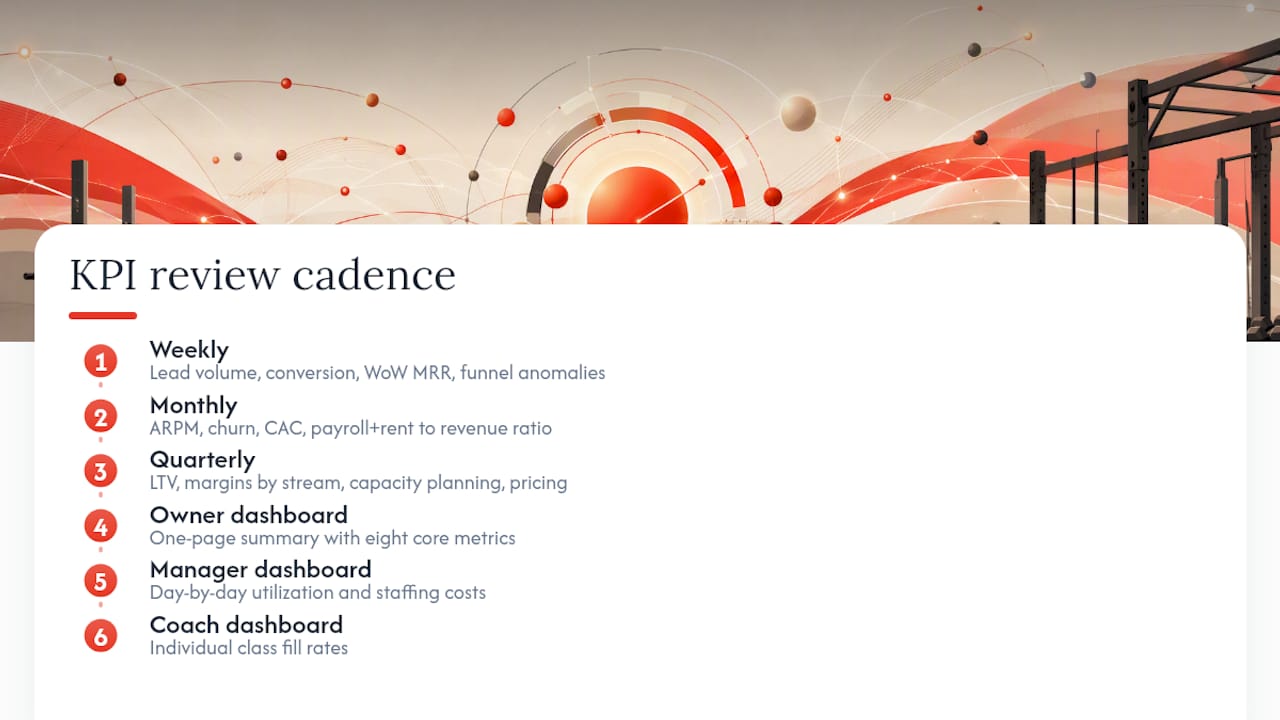
Weekly, glance at lead volume, conversion rate, week-over-week MRR movement, and any sudden funnel anomaly, like a spike in trial no-shows.
Monthly, dig into ARPM, churn, CAC, and the ratio of payroll and rent to total revenue. These numbers shift slowly, so monthly review is frequent enough to catch a trend without overreacting to a single bad week.
Quarterly, recalculate LTV, review margins by revenue stream, and reassess capacity planning and pricing. This is also when a schedule or staffing overhaul makes sense, since you want a full quarter of utilization data before restructuring class times.
Build three dashboard views: an owner’s one-page summary with the eight core metrics, a manager’s operational view with day-by-day utilization and staffing costs, and a coach or class-level view showing individual class fill rates. Keep cohort definitions and period boundaries consistent across every report, comparing calendar months to calendar months, not a 28-day month against a 31-day one.
Pro Tip: If lead volume is strong but revenue isn’t following, don’t increase ad spend. Fix ARPM and utilization first. Weak operational ratios, not weak marketing, are the more common culprit when growth stalls.
How Software Turns Raw Gym Data Into KPIs
A gym management platform earns its subscription fee by pulling sales, bookings, billing, check-ins, and retail transactions into one system, then doing the math automatically instead of leaving you to reconcile four spreadsheets every Sunday night. Fitness Flow centralizes those inputs and outputs automated MRR tracking, churn cohort breakdowns, an LTV calculator, and utilization heatmaps that show exactly which class slots are dead weight.
Fitness Flow clients report a 27% average increase in member retention and roughly 12 hours saved weekly on administrative tasks, time that shifts from spreadsheet wrangling into member-facing work.
When evaluating any KPI-capable platform, check for:
- Clean data export so numbers aren’t locked inside a proprietary dashboard.
- Native integrations with your payment processor and booking system.
- Flexible reporting that lets you build owner, manager, and coach-level views separately.
My Advice: Start Small, Automate Fast, Adjust Often
In the first 30 days, pick three KPIs, not eight, and build a simple spreadsheet to track them weekly while you fix any obvious data gaps. By day 90, automate your report pulls, set real numeric targets, and run one retention experiment. By day 180, revisit pricing tiers if ARPM is soft, rebalance your schedule based on utilization data, and reassess whether your CAC still makes sense.
— Louis
Fitness Flow: Stop Rebuilding Your KPI Report Every Sunday Night
Spreadsheets and disconnected booking, billing, and marketing tools force you to manually reconcile numbers that should already talk to each other. Fitness Flow is built to eliminate that reconciliation work entirely, one system pulling sales, scheduling, billing, check-ins, and member engagement data into the automated MRR, churn, and utilization reports covered above.
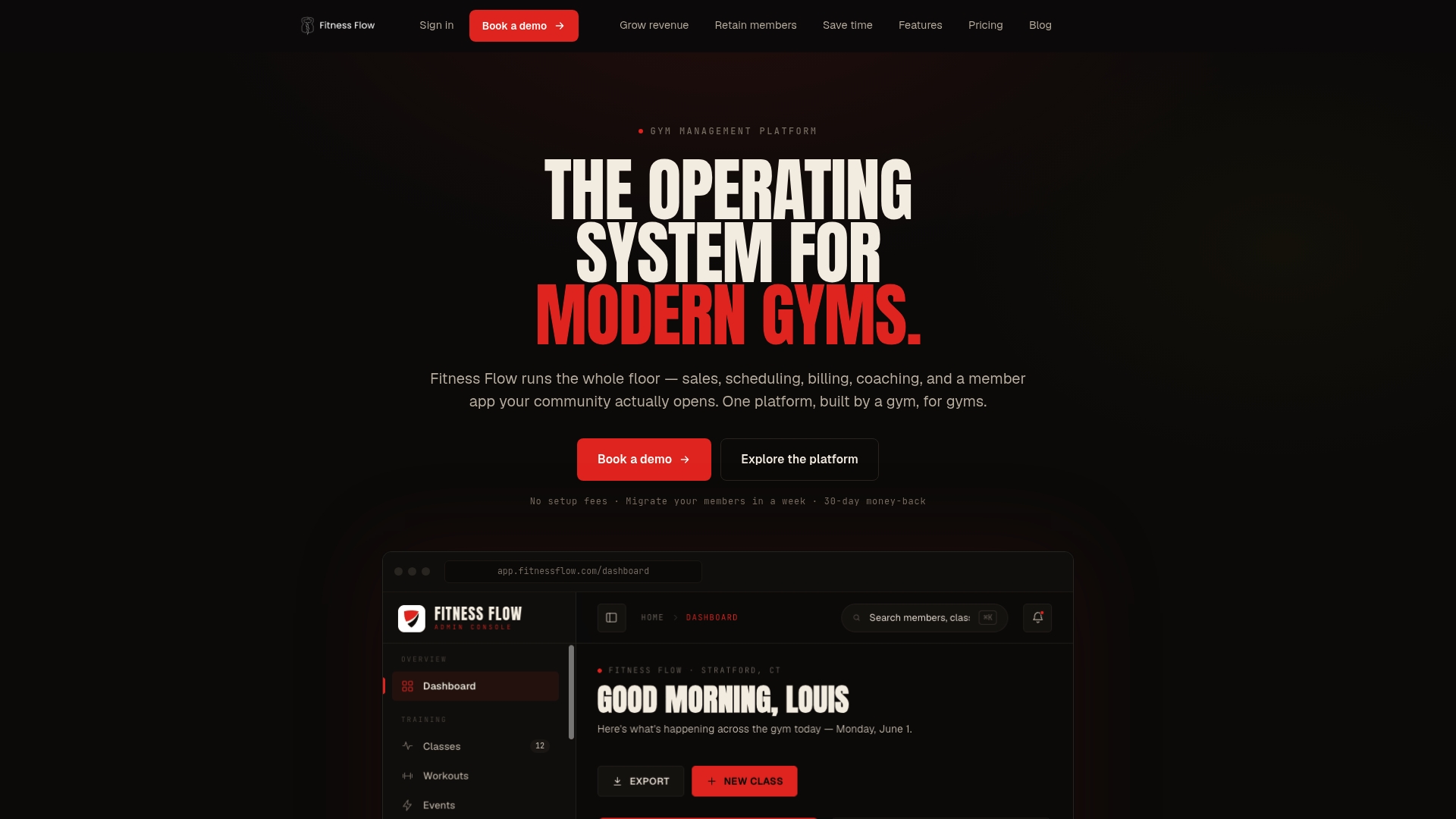
Instead of exporting three spreadsheets to calculate ARPM by hand, you open one dashboard. The branded member app adds a retention layer most standalone billing tools skip entirely: live classes, gamified engagement, and a direct line to members between visits. If you’re ready to see your churn, LTV, and utilization numbers update themselves instead of waiting for month-end, request a demo of Fitness Flow and get your first real-time dashboard running this week.
Where These Benchmarks and Formulas Come From
The revenue growth figure and model-specific benchmark ranges cited above come from industry gym metrics research. Member-level fitness measurement guidance draws on clinical testing standards from HSS and practical fitness benchmarks from Mayo Clinic.
Sources
- Key Gym Metrics Every Owner Must Track: MRR, LTV, Attrition & More
- When it comes to measuring your fitness, what really matters? | HSS
- Fitness testing and how to measure fitness | Mayo Clinic
FAQ
What Are the Five Key Performance Indicators for a Gym?
The five most watched are MRR, member lifetime value, churn rate, cost per acquisition, and utilization rate, with ARPM often tracked alongside them as a sixth core metric tying revenue to member count.
What Are the Top Three Gym KPIs to Track First?
If you’re starting from zero, track MRR, churn rate, and LTV:CAC ratio first: they reveal how much money is coming in, how fast you’re losing members, and whether your marketing spend is actually profitable.
What Are Some Good Gym KPI Examples in Practice?
Platforms like Fitness Flow automate these calculations directly from billing and booking data instead of requiring manual spreadsheet work.
How Do I Know If My Gym’s KPIs Are Healthy?
Compare your numbers against your specific gym model, boutique, big-box, or hybrid, rather than a universal benchmark, and prioritize your LTV:CAC ratio alongside churn since a strong ratio with rising churn still signals trouble ahead.