

Stop Gym Chargebacks in 20–45 Days, Plus When to Refund for Gym Owners

Most gym chargebacks are preventable, and a large share of the ones that do land are winnable, provided you gather the right evidence and move before your processor’s deadline passes. Winning requires a signed agreement, a recognizable billing descriptor, proof the member actually used the gym, and a submission timed to the network window your processor sets. For a small disputed amount, refunding often costs less than fighting; for a full annual membership or a pattern of repeat charges, representment is usually worth the effort.
TL;DR:
- Recognizable billing descriptors and signed consent forms are the simplest way to prevent most gym chargebacks.
- Centralized record-keeping of agreements, attendance, and communications enables quick, organized responses when disputes occur.
- Charging higher dispute fees or labor costs for small amounts often makes refunds the better option than fighting, unless the value of the membership justifies it.
- Most disputes stem from descriptor confusion or cancellation failures, not fraud, making process improvements more effective than fraud detection.
- Responding to chargebacks quickly with organized, relevant evidence and a clear rebuttal significantly improves chances of winning representment.
Getfitnessflow
Simplify Your Gym’s Billing Operations
Fitness Flow brings billing, scheduling, sales, and member engagement together, helping gym owners reduce administrative workload with one platform.
Table of Contents
- What Is a Gym Chargeback, and Why Does It Matter?
- What Chargeback Scenarios Show Up Most at Gyms?
- Prevention Checklist: Practical Steps That Cut Disputes
- How Do You Dispute a Chargeback and Win Representment?
- When Should You Refund Instead of Fighting the Dispute?
- How Centralized Systems Cut Chargeback Response Time
- What Gym Owners Get Wrong About Chargebacks
- A Practical Way to Lower Your Chargeback Exposure
- Sources
- FAQ
What Is a Gym Chargeback, and Why Does It Matter?
A chargeback is not a refund. A refund is money you choose to return; a chargeback is a forced reversal initiated by the cardholder’s bank, and the card issuer, not you, decides who wins. That distinction shapes everything else in this article.
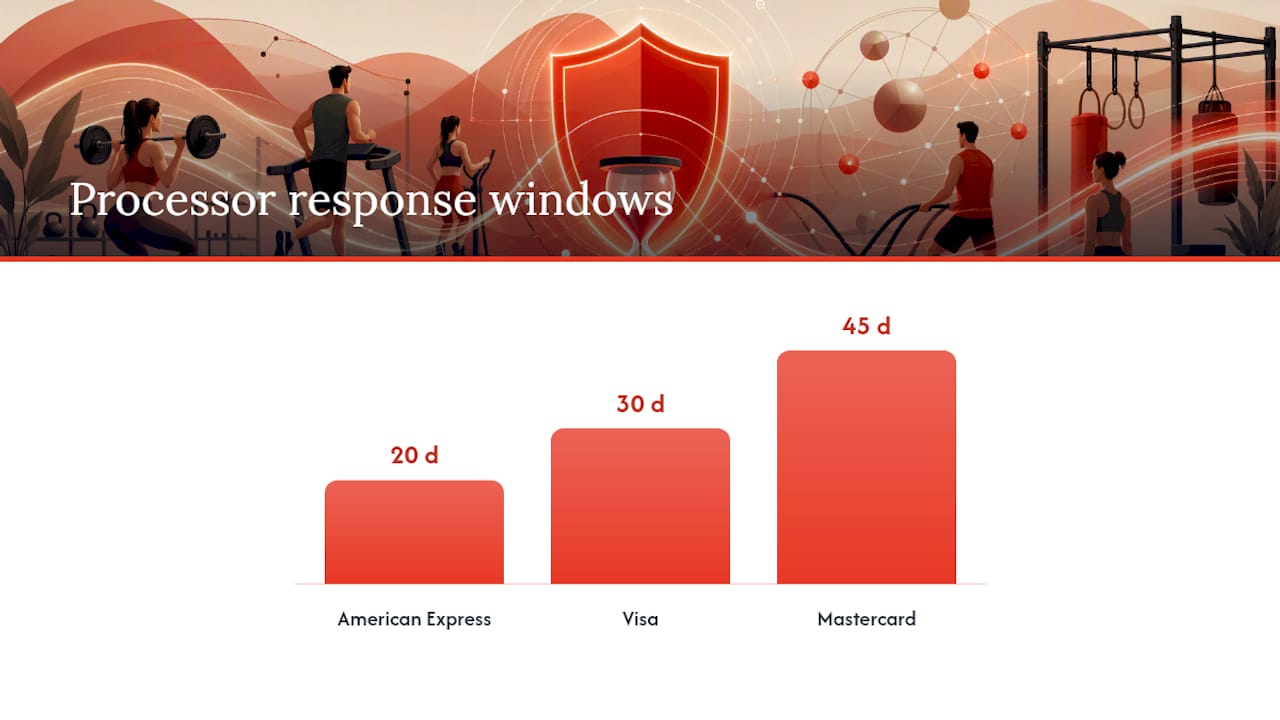
The financial hit goes beyond the disputed amount. You lose the original revenue, pay a dispute fee that your processor sets (terms vary and it is worth asking whether that fee gets refunded if you win), and burn staff hours assembling evidence. Rack up too many disputes relative to your transaction volume, and your processor may flag your account for monitoring or, in extreme cases, terminate it. Card networks and processors also run on different clocks: Visa gives you 30 calendar days to respond to a dispute, Mastercard allows 45, and American Express sets a tighter 20 day window, but your processor typically imposes an earlier internal cutoff than any of those network limits.
What Chargeback Scenarios Show Up Most at Gyms?
Certain patterns repeat across the fitness industry, and recognizing them helps you spot where your own systems are leaking money.
- Unrecognized descriptor disputes: a family member sees an unfamiliar charge on a shared card and disputes it before asking anyone in the household.
- Post-cancellation billing: the member canceled, believes it was processed, but your system kept charging because the cancellation was never logged.
- Duplicate or incorrect charges: a billing error, double run, or wrong tier price triggers a legitimate dispute.
- Service-not-rendered claims: a member argues they never used the facility, whether true or not.
- Friendly fraud: the member did authorize the charge but disputes it anyway, hoping for an easy refund instead of going through you directly.
Industry patterns suggest most fitness disputes trace back to descriptor confusion or cancellation-process failures rather than actual card theft, which is good news: those causes are fixable with process changes, not fraud-detection software.
Prevention Checklist: Practical Steps That Cut Disputes
Prevention is cheaper than any representment, and most of it comes down to paperwork and timing discipline.
- Use a recognizable descriptor. Set a clear, brand-matching statement descriptor (up to 22 characters) and confirm it with your processor before launch. A member who does not recognize “XYZ FIT 0472” on a bank statement will call their bank before they call you.
- Capture signed, informed consent. Retain a signed membership agreement and explicit consent for recurring card-on-file billing. This single document is often the deciding factor in a representment.
- Make cancellation genuinely easy. Offer an online cancellation option and send a written confirmation stating the effective date. If canceling requires a phone call during business hours, expect more disputes, not fewer.
- Log proof of use. Door check-ins, app activity, and class bookings all establish that a member kept using the service, which undercuts “I never went” claims.
- Time your renewal notices. Send renewal and price-change notices with enough lead time to satisfy network rules, generally at least seven days before a promotional rate ends.
- Train staff on cancellation workflows. A cancellation request that sits in an inbox for two weeks before entry into your billing system is how “we canceled it” disputes happen.
- Audit account lifecycles regularly. Frozen memberships, paused accounts, and family plans are common places where a rollover charge slips through unnoticed.
Pro Tip: Keep a rolling folder of consent screenshots, signed contracts, and descriptor confirmations organized by member name. When a dispute notice lands, you want to build the packet in minutes, not hours.
Clear agreements, transparent communication, and disciplined record-keeping form the real foundation of chargeback prevention for any gym, regardless of size.
How Do You Dispute a Chargeback and Win Representment?
Representment is your formal rebuttal to the bank, and speed plus organization decide most outcomes.
- Check the deadline on the notice, not the network rule. Your processor’s stated deadline will usually fall before the 30 day Visa, 45 day Mastercard, or 20 day American Express windows that apply at the network level.
- Assemble your evidence chronologically. Pull the signed agreement, consent record, full billing history, proof of use such as check-in or app logs, any cancellation communication, and a screenshot of your billing descriptor as it appears on statements.
- Write a short cover letter tied to the reason code. Address exactly what the issuer flagged, whether that’s “unauthorized,” “not as described,” or “canceled.” A winning submission rebuts the reason code directly with labeled exhibits rather than a long narrative explaining your business philosophy.
- Submit through your processor and track it. Note the submission date and follow up if you don’t hear back within the stated review window.
- Log the outcome either way. A loss tells you where a process broke down. Essential evidence for a winning gym representment almost always includes the signed agreement, proof of service, and communication records together, not any one of them alone.
- Build a reusable playbook. Save template exhibits and cover-letter language for your most common scenarios so the next dispute takes an hour, not a day.
Most losses happen not because the gym lacks the facts, but because the evidence never gets pulled together and filed before the clock runs out.
When Should You Refund Instead of Fighting the Dispute?
Not every dispute deserves a fight. Run a quick calculation: add the disputed amount, the dispute fee, and the staff hours a representment will cost, then weigh that against your realistic odds of winning based on the evidence you actually have.
A $40 monthly charge with thin documentation usually isn’t worth a multi-hour representment. A $600 annual membership with a signed contract and solid check-in logs almost always is. Factor in the member’s lifetime value and the reputational cost of fighting a borderline case publicly. Refund strategically when the math says so, but always trace the root cause. A descriptor fix or a better cancellation flow prevents the next ten disputes, not just this one.
How Centralized Systems Cut Chargeback Response Time
Gyms running consent forms, billing, and attendance in separate tools lose time hunting for evidence during a deadline crunch. Centralizing those records means a consent timestamp, an in-app check-in, and a class booking sit in one place, ready to export the moment a dispute notice arrives. The strongest submissions pair a signed agreement with proof of use pulled directly from a member’s account activity. A saved dispute-packet template, built once and reused every time, let’s staff respond well inside the processor’s deadline instead of racing it.
What Gym Owners Get Wrong About Chargebacks
The conventional advice treats chargebacks as a legal problem: get a better contract, add more fine print, hope it holds up. That misses the actual failure point. Most disputes are lost on logistics, not law. The gym had the facts. Nobody pulled them together before the deadline.
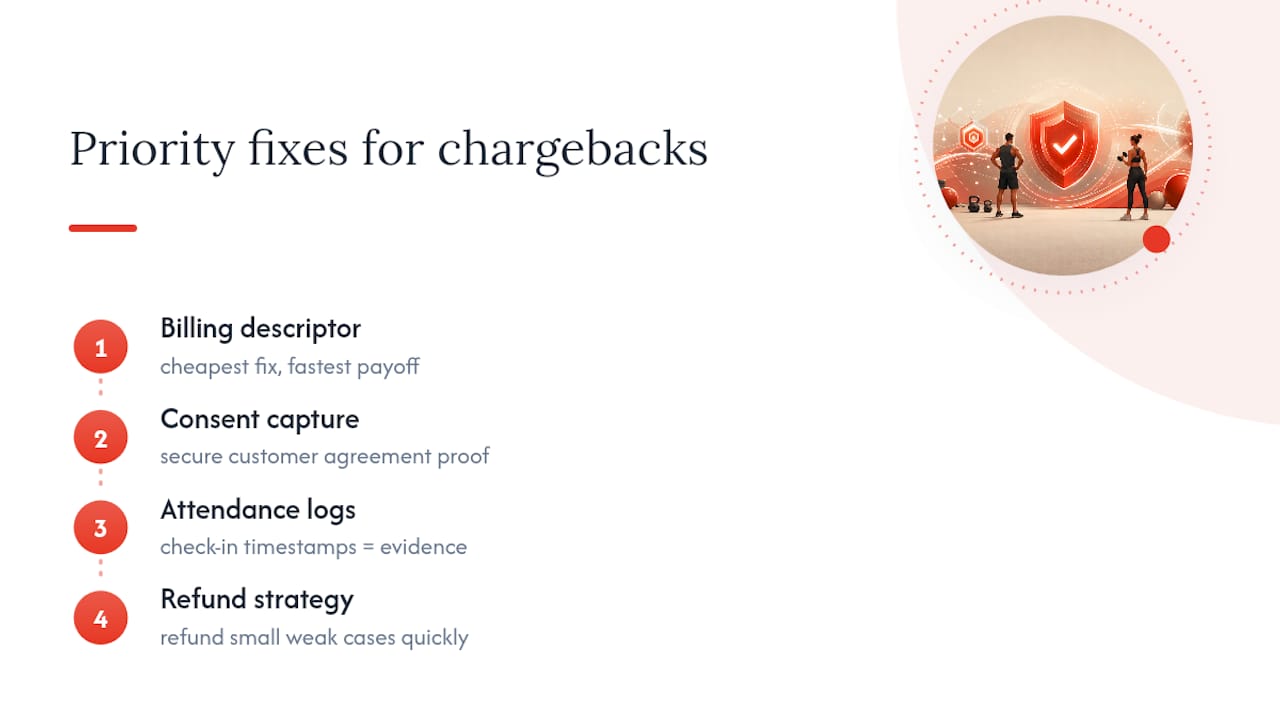
The overlooked lever is proof of use. Owners obsess over airtight cancellation clauses while ignoring that a stack of check-in timestamps often does more to defeat a “service not rendered” claim than any contract language ever could. If I had to rank priorities for a gym owner starting from zero, it would be: fix your billing descriptor first, because it’s the cheapest fix with the fastest payoff; nail down consent capture second; and treat attendance logging as evidence infrastructure, not just a retention metric.
The other place conventional wisdom fails is the refund decision. Too many owners treat every dispute as a fight worth having, on principle. That’s an expensive way to run a business. Small-dollar disputes with weak paperwork should get refunded fast and used as a signal to fix a process, not as a hill to defend.
— Louis
A Practical Way to Lower Your Chargeback Exposure
Most of the prevention checklist above requires the same underlying thing: your consent records, billing history, and attendance data living somewhere you can pull them together fast. A well-designed gym management platform can centralize recurring billing, membership agreements, and consent capture in one system, and log member activity, including check-ins and class bookings, through a branded member app.

That combination maps directly onto what wins a representment: a signed agreement, a documented consent timestamp, and proof of use, all pulled from one place instead of three. Automated cancellation confirmations also close the gap where “I thought I canceled” disputes usually start. If chargeback losses have been eating into your margins, it’s worth seeing how the Solo, Studio, and Multi-site plans handle billing and evidence capture. Request a demo at Getfitnessflow to see the consent and attendance logs in action before your next renewal cycle.
Sources
For deadline specifics, consult Chargebacks 911 on response time limits. For legal guidance on prevention and representment, see Gym Lawyers and The Association of Fitness Studios. Gyms working on upstream retention and communication may also find value in SEO services built for fitness businesses.
- Chargebacks 911 — chargeback response time limit
- Understanding and Preventing Chargebacks for Gym Owners — Gym Lawyers
- Can I dispute a gym membership charge on my account — Catalyst Legal
- How to Handle Chargebacks: A Legal Guide for Gym Owners — The Association of Fitness Studios
FAQ
Can You Dispute a Gym Membership Charge?
Yes. A cardholder can file a chargeback on a gym membership charge, but issuers generally expect the member to attempt a direct resolution with the gym first, documenting the dates and amounts involved. Skipping that step doesn’t bar the dispute, but it weakens the member’s position if the gym can show good-faith billing practices.
Can Gym Owners Get in Trouble for Fighting Chargebacks?
No, disputing a chargeback through proper representment is a normal, legitimate business process. The risk isn’t legal trouble; it’s practical: too many disputes relative to your transaction volume can trigger processor monitoring or account review, which is why prevention matters more than winning any single case.
What Happens if a Gym Membership Goes to a Debt Collector?
Unpaid membership balances can be sold or assigned to a collection agency per the terms in the signed agreement, which may affect the member’s credit report. Gyms should keep clear records of the original contract and any missed payments before escalating an account to collections.
Can You Get Blacklisted for Not Paying a Gym Membership?
There’s no universal fitness industry blacklist, but unresolved unpaid balances sent to collections can appear on a member’s credit report and affect future financing. Some payment processors also track excessive disputes tied to a specific card, which can make it harder for that member to open new recurring billing agreements elsewhere.
What Is the Best Evidence to Include in a Chargeback Response?
The strongest packet combines the signed membership agreement, proof of service like check-in or app logs, and communication records tied to cancellations or billing questions. A platform like Getfitnessflow that centralizes these records makes assembling that evidence faster when a deadline is close.