

Recover Failed Memberships: 5 Step Dunning Emails for Gyms

Run an automated dunning workflow that starts with a tokenized, no-login payment update link at hour 0, then follows a defined retry and escalation schedule through day 14. This structure, paired with SMS for members who ignore email, typically recovers most failed gym membership payments without a single collections call. The rest comes down to timing, tone, and tracking the right numbers.
TL;DR:
- Automated dunning sequences recover the majority of failed gym membership payments within 14 days, primarily through timely emails and SMS follow-ups.
- Sending members a no-login tokenized payment update link immediately after failure significantly increases the chances of successful recovery.
- High-value members with long-term plans or personal training packages should be prioritized for staff callbacks at the 3 to 7-day mark to maximize recovery potential.
- Logging every attempt and outcome ensures dispute resolution is transparent and audit-ready, which is vital for maintaining member trust.
- Using an integrated platform like Fitness Flow streamlines automation, reduces administrative work, and increases overall member retention by nearly 27 percent.
Getfitnessflow
Keep Members Connected Between Visits
Fitness Flow brings billing, scheduling, member engagement, and analytics together in one platform built for modern gyms.
Table of Contents
- What Is a Gym Dunning Sequence and Why It Matters for Revenue
- Recommended Dunning Sequence for Gyms: Timing and Retry Schedule
- Email and SMS Templates for Payment Recovery
- How Tokenized Payment Links Boost Recovery Rates
- Segmentation: Who Gets a Human Call, and When
- Benchmarks and KPIs for Dunning Program Performance
- Technical Setup: Webhooks, SMS, and Access Control
- How Fitness Flow Handles Dunning for Gym Operators
- Dunning Is Retention, Not Punishment
- Fitness Flow: Automate Your Gym’s Dunning Workflow
- Sources
- FAQ
What Is a Gym Dunning Sequence and Why It Matters for Revenue
A dunning sequence is the automated chain of emails, texts, and access rules a gym triggers the moment a membership payment fails. The term comes from collections work, but for a gym it functions closer to a save campaign than a threat letter. Every card that expires, every ACH transfer that bounces, and every insufficient-funds decline puts a real member at risk of silently churning, not because they wanted to quit, but because their bank rejected a routine charge.
Failed payments are common. Card networks reissue numbers constantly, checking accounts run temporarily low around payroll cycles, and members rarely notice a decline until their gym access stops working. A configured dunning sequence with notifications, retries, and a pause step recovers a much higher share of failed payments than manual follow-up, largely because it acts within hours instead of whenever a front-desk staffer gets around to checking the billing report.
The financial stakes are bigger than they look on a monthly P&L. A gym billing 2,000 active members might see 4 to 8% of charges fail in any given cycle from card expirations alone. Left unmanaged, a meaningful share of those members quietly lapse. Recovered, they never notice the hiccup happened.
Recommended Dunning Sequence for Gyms: Timing and Retry Schedule
The sequence below reflects what fitness billing platforms and payment processors converge on as the standard cadence, adjusted for how gyms actually operate.
- Hour 0 to 2: The instant a charge fails, send an automated email with a tokenized, no-login payment update link. No portal login, no app download requirement. This is the single highest-converting touchpoint in the entire sequence.
- Hour 24: Retry the card automatically. Card declines (insufficient funds, expired card, bank flag) resolve fast when they resolve at all, so a same-day or next-day retry catches members whose issue was temporary.
- Day 3: Send a second notification. If the failure was an ACH return rather than a card decline, wait longer, 24 to 72 hours, before retrying, since bank transfers process on a slower clock and an immediate re-attempt can trigger another return or a fee.
- Day 3 to 7: Escalate tone slightly and add SMS or app push for members who haven’t opened the previous emails. This is also where high-value member segmentation should kick in.
- Day 7 to 14: Restrict or pause facility access, send a final notice, and route high-value accounts to a staff member for a personal call before the account lapses entirely.
Documented five-step workflows built specifically for gym billing failure recovery follow nearly this exact structure: immediate notification, 24-hour retry, 48-hour escalation, 72-hour access restriction, and a day-7 staff escalation for members who haven’t responded.
A few rules govern every step:
- Stop the sequence immediately the moment payment succeeds, mid-sequence or not.
- Never send more than one message per channel per day, even during escalation.
- Card retries can run on a tight 24- to 48-hour clock; ACH retries need a longer 24- to 72-hour window to avoid compounding return fees.
- Log every attempt (channel, timestamp, outcome) for later dispute resolution.
Pro Tip: Add a pre-dunning layer before any of this starts. Sending a card-expiry reminder 30, 14, and 7 days before a card expires prevents a large share of failures from ever reaching the dunning sequence at all.
Email and SMS Templates for Payment Recovery
Copy matters as much as timing. A dunning email that reads like a threat gets ignored or, worse, gets a member calling to cancel out of frustration. A dunning email that reads like a helpful nudge gets clicked.
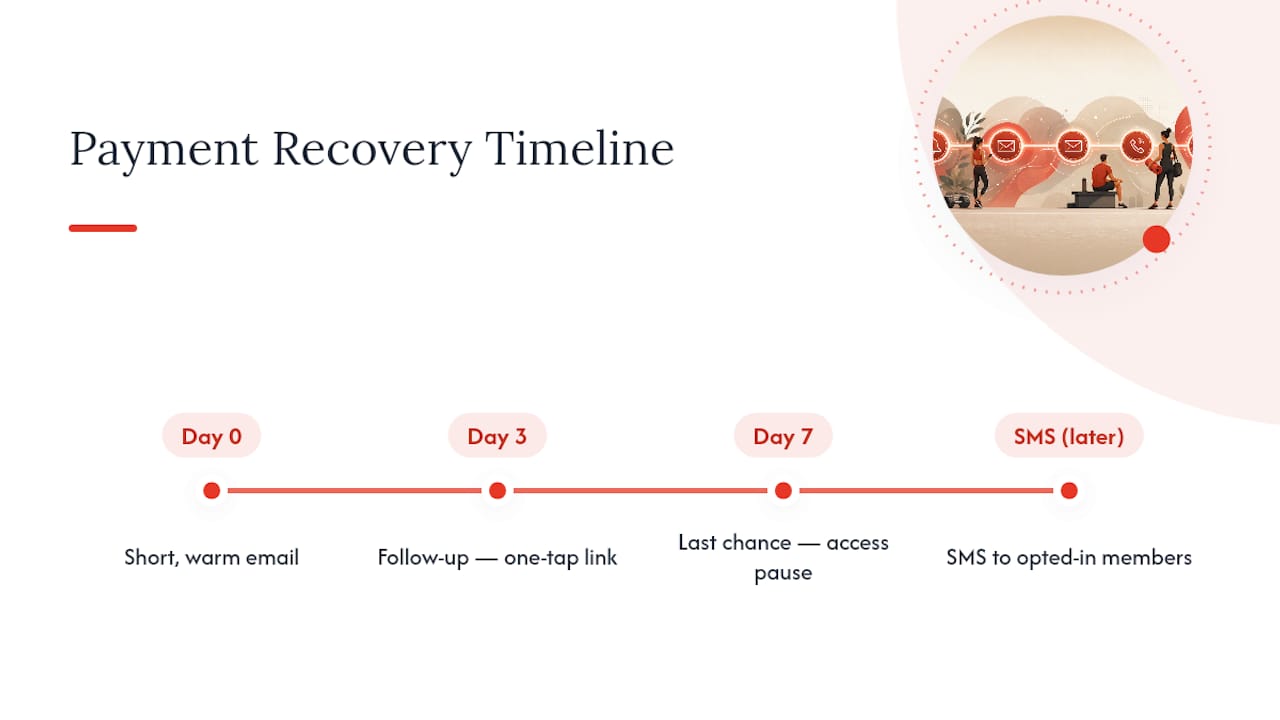
Day 0 email should be short, warm, and action-first. Subject line: “Quick fix needed for your membership” or “Your card didn’t go through, here’s a 30-second fix.” Send from a real staff name, not a “no-reply” address, since tokenized update links paired with clear, helpful copy increase recovery and reduce involuntary churn far more than a generic system alert does.
Day 3 email raises urgency slightly without blaming the member. Subject line: “We still couldn’t process your payment” works better than anything with “overdue” or “past due” in it. Include the same one-tap link.
Day 7 email is the last chance before access changes. Subject line: “Your gym access pauses in 3 days” is direct without being aggressive. This is also the email that must include a clear, visible link for members who genuinely want to cancel, since burying the exit option only generates complaints and disputes later.
SMS, reserved for day 3 or later non-responders, should be brief: “Hi [Name], your [Gym Name] payment didn’t go through. Update it here in 30 seconds: [link]. Reply STOP to opt out.” Only send SMS to members who’ve opted into text communication.
Pro Tip: A/B test two subject lines per email, one framed as a fix (“Update your payment in 30 seconds”) and one framed as a status update (“Your membership needs attention”). Fix-framed subject lines tend to outperform status-framed ones because they promise resolution, not just information.
How Tokenized Payment Links Boost Recovery Rates
The single biggest lever in the entire sequence is what happens after a member clicks the link. Send them to a portal login screen and most will abandon before entering credentials. Send them to a one-tap, pre-authenticated form and most will finish in under a minute.
Tokenized links work by generating a unique, single-use identifier tied to that member’s account and that specific billing failure. The token should expire, typically within 72 hours to a week, and should be invalidated the moment it’s used or the payment clears, whichever comes first.
Build the update page mobile-first, since most members will click from a phone. Minimize fields to just the new card number, expiry, and CVV. Use a PCI-compliant hosted payment page or redirect rather than building your own card-capture form, which shifts compliance burden onto a certified processor instead of your own servers.
What to log for every token:
- Token ID and the member/billing-failure it’s tied to
- Click timestamp and device type
- Whether the update succeeded, failed, or the token expired unused
- Time from link click to completed payment
Tokenized, single-use update links that skip portal logins increase conversion dramatically compared to sending members back through a full account login, which is exactly why every step in the sequence above should default to this link type first.
Segmentation: Who Gets a Human Call, and When
Not every failed payment deserves the same response. A member on a month-to-month plan who’s been with you for six weeks doesn’t need the same treatment as a member with an annual contract and a personal training package.
Define high-value criteria upfront:
- Annual or prepaid plans (higher lifetime value at stake)
- Tenure over 12 months (loyalty worth protecting)
- Active personal training or add-on packages
- Members flagged in your CRM as referral sources
Route these accounts to a staff callback queue automatically once they hit the day 3 to 5 mark without resolving. Pre-populate the staff member’s screen with the member’s name, plan type, failure reason, and how long they’ve been a member, so the call sounds informed, not scripted.
High-value members respond well to a human callback path; a short, supportive call recovers a disproportionate share of at-risk revenue precisely because it doesn’t sound like collections. Train staff to open with “we noticed your card had an issue” rather than anything about balances owed.
Pro Tip: Give staff a simple rule: never mention a dollar amount owed on the first call. Frame it entirely as a payment method issue, not a debt.
Automate the queue itself so accounts drop in and out without a manager manually tracking spreadsheets.
Benchmarks and KPIs for Dunning Program Performance
Four numbers matter more than the rest: initial recovery rate (percentage resolved within 48 hours), total recovered revenue, average time-to-recovery, and reduction in involuntary churn compared to your pre-automation baseline.
MetricWhat it tells youWhere to check it
Initial recovery rate
How well hour-0 to day-1 messaging performs
Payment gateway retry logs
Time-to-recovery
Average hours/days from failure to resolved payment
CRM or billing dashboard
Involuntary churn reduction
Members who lapsed due to payment failure vs. total failures
Monthly retention report
Token conversion rate
Percentage of link clicks that complete payment
Link analytics/token logs
Report performance by channel, not just in aggregate. If email opens are healthy but conversion is flat, the problem is likely the landing page, not the message. If SMS click-through outpaces email for the same cohort, shift more non-responders to text sooner.
Run ongoing A/B tests on three levers: retry timing (24 vs. 48 hours), subject-line framing, and channel sequencing (email-only vs. email-plus-SMS at day 3). Small shifts in any of these compound across thousands of billing cycles a year.
Technical Setup: Webhooks, SMS, and Access Control
Building this without manual spreadsheet-chasing means wiring your payment gateway, communications tool, and gym management software together at a few specific points.
Subscribe to payment_failed and payment_succeeded webhook events at minimum, capturing member ID, failure reason code, amount, and timestamp on every event. The failure reason code matters more than most operators realize, since a card decline and an ACH return need different retry logic entirely.
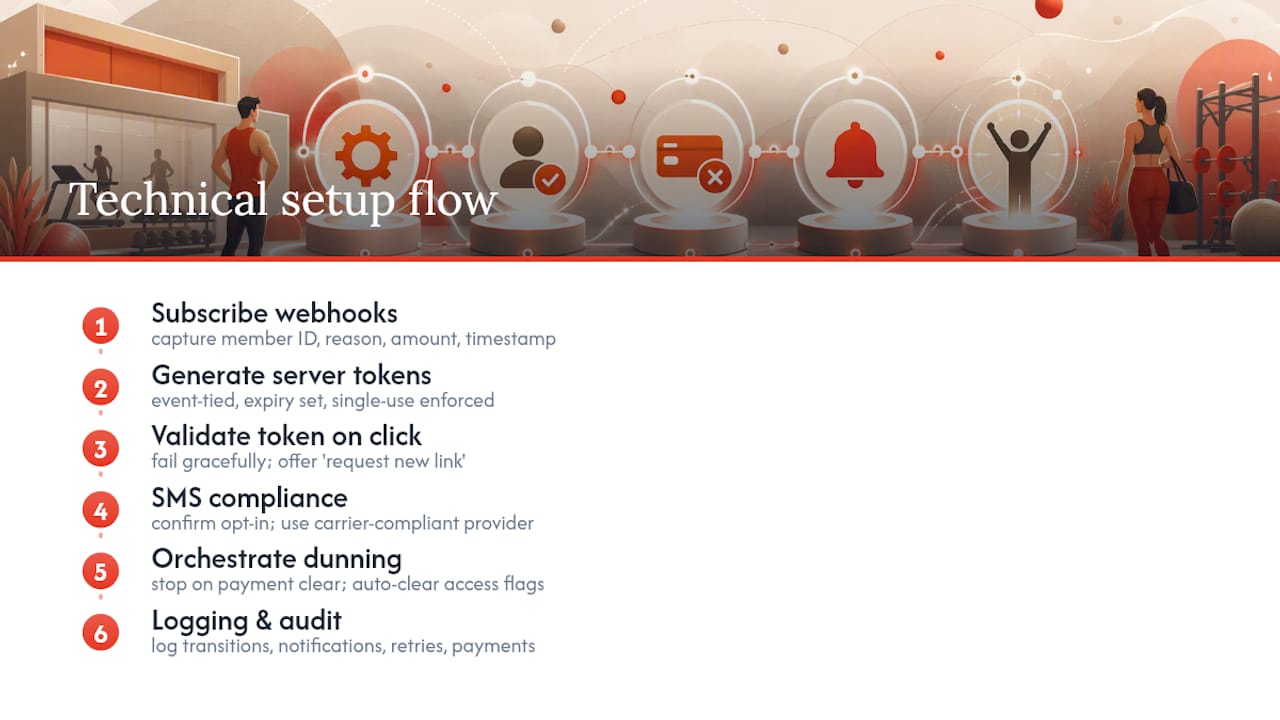
Generate tokens server-side, tied to the specific billing failure event, with a defined expiry and single-use enforcement. Validate the token on click, not just on submission, so an expired link fails gracefully with a “request a new link” option instead of an error page.
For SMS, confirm opt-in status before every send and route messages through a provider that follows carrier compliance standards. CTIA’s messaging interoperability guidance covers the deliverability and carrier-filtering rules that determine whether your texts actually land, and FCC guidance on telemarketing and automated messaging governs the opt-in and content requirements you’re legally bound to follow.
The orchestration layer should terminate the dunning sequence the instant a payment clears and auto-clear any access-restriction flags. Every state transition, notification sent, retry attempted, access changed, payment resolved, needs to be logged for audit purposes and for resolving member disputes later.
That logging requirement isn’t optional paperwork. When a member disputes a charge or claims they were locked out unfairly, a clean audit trail is the only thing that resolves it quickly.
How Fitness Flow Handles Dunning for Gym Operators
Fitness Flow builds these mechanics directly into its gym management platform: automated retry sequences, tokenized update links, push notifications through the branded member app, and analytics that show recovery performance by channel and step. Instead of stitching together a payment gateway, a separate SMS tool, and a spreadsheet for tracking, everything runs from one system.
Gyms using an integrated gym management platform report a notable increase in member retention and save significant administrative time that used to go toward manually chasing declined cards. For a small-to-midsize gym running lean on staff, that difference between an integrated system and a patchwork of disconnected tools shows up directly in how many members quietly lapse each month.
Dunning Is Retention, Not Punishment
The instinct to treat a failed payment like a debt collection problem is understandable and mostly wrong. Most declines aren’t a member trying to avoid paying. They’re a bank doing its job, flagging a card, bouncing a transfer, and the member usually has no idea until they show up and their key fob doesn’t work.
The best rule of thumb: recover the revenue, but never make a member feel accused of something they didn’t do. If your day 7 email reads like a warning label, rewrite it. Pull up your current sequence this week and read it as if you were the member receiving it, not the owner sending it.
— Louis
Fitness Flow: Automate Your Gym’s Dunning Workflow
Fitness Flow eliminates the multi-tool billing chaos most gyms deal with by handling payment recovery, member communication, and retention analytics inside one platform instead of three separate subscriptions.
The platform’s automated dunning tools cover the full sequence outlined above without manual configuration:
- Automated retries timed by decline reason (card vs. ACH)
- Tokenized, no-login update links built into every notification
- Push alerts through your gym’s branded member app for non-responders
- Channel-level analytics showing recovery rate by step and touchpoint
Gyms running Fitness Flow report a 27% average retention lift and save about 12 admin hours weekly, hours that used to disappear into manually flagging failed charges and calling members one by one. If your team is still exporting a failed-payments report every Monday morning, that’s the gap Fitness Flow closes.
Plans start with entry-level and mid-tier subscriptions, with pricing and multi-site options available on request. For the latest details, check the provider’s official website. Check Fitness Flow’s plans and book a demo to see the dunning workflow running against your actual member data. For a deeper look at how retention strategy connects to payment recovery, the Raw is worth a watch alongside your setup.
Sources
- Telemarketing and robocalls | Federal Communications Commission
- Messaging interoperability (CTIA)
- Dunning emails 101: What they’re for, and how to write them (Stripe)
- How Can Gyms Set Up Recurring Billing? | ReliaBills
FAQ
What Does “Dunning Email” Mean?
A dunning email is an automated message sent after a payment fails, prompting the customer to update their payment method or resolve the issue. In a gym context, it’s the notification a member gets when their card or bank transfer didn’t process, paired with a link to fix it in seconds.
What’s the Right Way to Cancel a Gym Membership?
Check your contract for the required notice period and cancellation method, since many gyms require written notice or a specific form rather than a phone call. A dunning email you receive after a failed payment should always include a visible cancellation or exit link if you genuinely intend to end your membership rather than just update a card.
Is It Illegal for Gyms to Make Cancellation Difficult?
Consumer protection laws vary by state, but many jurisdictions require gyms to offer a cancellation method at least as easy as the sign-up process, and deliberately obstructing cancellation can trigger regulatory complaints. Gyms that build a clear, low-friction exit path into their billing communications, as Fitness Flow’s automated sequences do, avoid this risk entirely while still giving payment recovery a fair chance first.
Can I Get Out of a Gym Contract Early?
Most gym contracts include specific early-termination clauses covering relocation, medical hardship, or a buyout fee, so review your signed agreement for those terms first. If no such clause applies, contacting the gym directly to negotiate, or checking state-level consumer protection rules on health club contracts, is the next step.
How Much of My Failed Payment Recovery Should Happen Automatically?
Most of it. A configured sequence with automated notifications, retries, and access rules recovers far more revenue than manual staff follow-up, reserving human calls for the small segment of high-value accounts that benefit most from personal attention.